

Effective Link Building Tactics for eCommerce Brands
Introduction: Why Link Building Matters for eCommerce Brands
Link building. It’s the phrase that makes most eCommerce marketers groan.
Why? Because it sounds hard, it looks technical, and most tutorials online either oversimplify it or drown you in jargon. You’ve probably heard the core truth: backlinks are votes of confidence that help Google understand your site’s authority. That part is simple enough.
But here’s what most eCommerce brands miss.
Link building isn’t about chasing volume. It’s not about 100 links from random fitness blogs when you sell kitchen appliances. And it’s certainly not about paying fifty pounds for a link on some dodgy directory that nobody reads.
Effective link building for e-commerce is surgical. It’s about strategic placements on relevant, trusted sites that send real traffic and signal real authority to Google. It’s about understanding your customer’s journey, the language they use online, and the communities and platforms where they actually spend time.
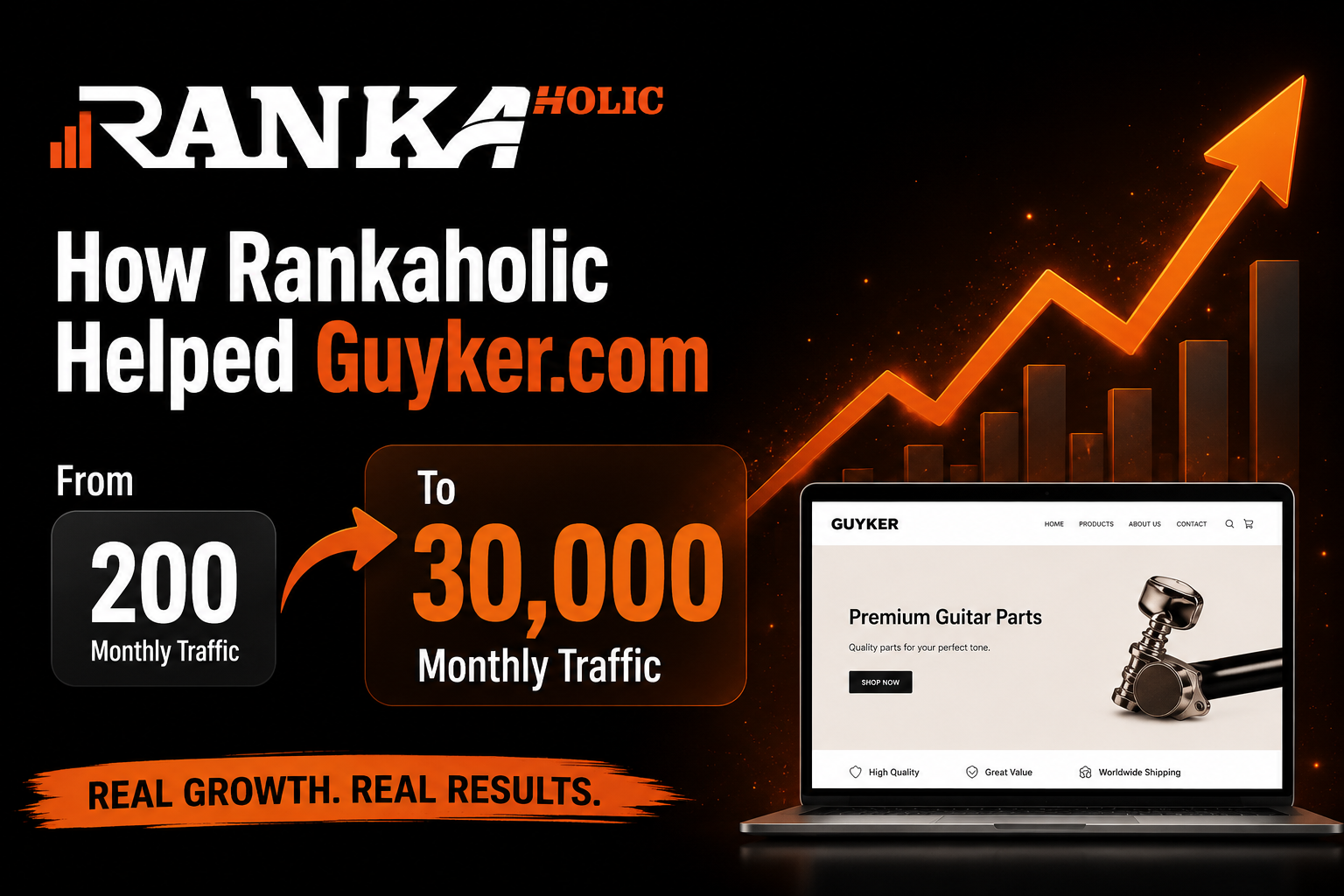
This is exactly what we learned when we helped Guyker, a premium guitar hardware brand, grow from 200 to 30,000 monthly organic visitors in just 12 months. Low traffic wasn’t their problem. Authority was. And once we fixed their backlink profile, their rankings followed, and so did their revenue.
In this guide, we’ll walk through the exact tactics we used, plus six proven link building strategies that work specifically for e-commerce brands. Whether you’re selling hardware, home goods, beauty products, or anything in between, these approaches will help you build genuine authority that Google trusts and that customers notice.
1. The Authority Problem: Why Most eCommerce Brands Fail to Rank
You can have perfect product pages. Flawless site speed. Brilliant on-page optimisation. And still rank on page 3 for your most important keywords.
The reason? Google doesn’t trust your domain yet.
This isn’t speculation. When we took on Guyker, they had 200 monthly US organic visitors but a Domain Rating of just 14. Their products were genuinely excellent. Their website was technically sound. But no reputable sites in the guitar and music space were linking to them. So Google had no reason to trust them as an authority.
The fix was clear: build their authority through high-quality, niche-relevant backlinks.
Here’s the thing about eCommerce especially. You’re competing against established brands with existing link profiles, brand mentions, and earned media coverage. A new or growing eCommerce site needs to compress that authority gap quickly. You can’t wait two years for natural links to trickle in.
That’s where deliberate, strategic link building comes in. It’s not cheating the system. It’s accelerating a process that would happen anyway if you had the marketing budget of Amazon.
For your eCommerce brand, the first step is honest assessment. Check your Domain Rating, your referring domains, and your anchor text distribution. Tools like Ahrefs, SEMrush, or our free DA PA Checker can give you a quick snapshot. If you’re significantly behind your top three competitors in domain authority, you’ve found your biggest opportunity.
2. Guest Posts: The Backbone of Strategic Link Building
Of all the link building tactics we use, guest posting remains the most reliable.
Here’s why. A guest post isn’t just a link in some random article. When done properly, it’s a piece of original, native content written specifically for your host site’s audience. It reads naturally. It adds value. And because of that, it earns trust from readers and search engines alike.
With Guyker, 62 of their 150 total quality backlinks came from guest posts on music and guitar blogs. That’s 41%. Not all links are equal, but guest post links are among the highest quality because they’re editorially earned.
The process we follow is rigorous:
Step 1: Research and vet the target site. We look for blogs with real organic traffic, a Domain Rating of 20 or above, a spam score under 5%, and a clean link profile. If any check fails, we remove them from consideration.
Step 2: Personalise outreach. Every email is handwritten to the individual site owner or editor. No templates. No mass blasts.
Step 3: Create original content. Our writers produce articles that sound native to the host site, not like SEO spam disguised as journalism. For Guyker, we created genuinely helpful pieces about guitar hardware, maintenance, and playability.
Step 4: Strategic anchor text. We use a natural mix of branded, semi-generic, and partial-match anchors. No over-optimisation. The link should read naturally in the article.
Step 5: Verify and report. Every link goes live, every placement is tracked, and every month you receive a full report showing links acquired, domain authority growth, and keyword movement.
For eCommerce, the key is finding blogs and publications that your customers actually read. If you sell outdoor gear, look for adventure travel blogs, camping review sites, and hiking forums. If you sell beauty products, target beauty bloggers, wellness publications, and lifestyle magazines. Your anchor text and backlink profile should tell a story about who you are and what you do.
3. Resource Page Placements: The Low-Hanging Fruit
Some of the easiest links to earn are already sitting on the web, waiting for you.
Resource pages are compilations. Best-of lists. Roundups of recommended tools or products. “Top 10 [Your Product Category]” guides. These pages exist in almost every industry, and they’re actively looking for quality products to feature.
With Guyker, 38 of their 150 links came from resource page placements on guitarists’ gear guides and music resource pages.
Why does this work? Because webmasters maintain these pages specifically to serve their audience with the best recommendations. If your product genuinely deserves to be on that list, you’ve found a win-win. The site owner gives their readers a valuable recommendation. You get a relevant, contextual link.
The outreach is straightforward. You find the page, research who maintains it, and pitch: “I noticed you’ve compiled a brilliant guide to [topic]. We’ve built [your product] to solve [specific problem]. I thought your readers might find it valuable.”
No aggressive selling. Just a genuine offer that benefits their audience.
For eCommerce, this tactic works especially well if your product is unique, solves a specific problem, or has earned genuine third-party recognition. If you’re in a crowded category (generic t-shirts, basic phone cases), it’s tougher. But if you’ve built something with a genuine point of difference, resource pages are your friend.
4. Roundup Mentions and Feature Placements
Bloggers and journalists love roundups. “Best tools for X.” “Top products in [category].” “We tested these five options—here’s what won.”
These articles drive readers directly to your site and signal relevance to Google.
Guyker earned 28 links through roundup inclusions and feature articles. These pieces appeared on music blogs, guitar review sites, and lifestyle publications where guitarists spend time. The links weren’t forced. They were natural inclusions in articles that had already been planned to feature products in that space.
The tactic here is proactive relationship building. You identify journalists, bloggers, and editors who write roundups and features in your space. Then you build a relationship with them over time. Share relevant news about your products. Offer them product samples. Be genuinely helpful without expecting immediate links.
When they’re planning their next roundup, you’ll be the first person they think of.
For eCommerce brands, this is especially powerful if you sell physical products. Journalists and reviewers love testing tangible goods and sharing their honest feedback. If your product is genuinely good, this approach converts regularly.
5. Brand Mention Reclamation: Converting Mentions into Links
Here’s something most eCommerce brands overlook completely.
Your brand is probably already being mentioned online. Reviewers are talking about you. Blogs are recommending your products. Customers are discussing you in forums. But not all those mentions include links.
Brand mention reclamation is simple: find pages that mention your brand or products by name but don’t link to you, then reach out and ask for the link.
With Guyker, we identified 8 high-authority pages that mentioned them by name but had no hyperlink. We contacted the site owners with a friendly request: “We noticed you mentioned Guyker in [article]. We’d love to see a link included—your readers would find it helpful.” Most agreed.
The email is short. The link is easy to add. There’s no barrier to saying yes.
The process is simple:
- Use a tool like Ahrefs, SEMrush, or Google Search Console to identify mentions of your brand.
- Filter for mentions without links.
- Prioritise pages with good domain authority.
- Reach out with a brief, friendly message.
For eCommerce, this tactic is surprisingly effective because product reviews, recommendation posts, and retailer features naturally mention your brand. A polite ask often results in a link added within days.
6. Product Review Outreach: Building Links Through Sampling
If your eCommerce brand sells physical products, product reviews are your secret weapon.
Bloggers, YouTubers, and journalists review products constantly. If your product is genuinely good, many of them will write about you and link to you—completely unprompted.
The key? Get your product in their hands.
This isn’t bribery or manipulation. It’s acknowledging that if a reviewer loves your product, they’re going to talk about it. And when they do, they’ll usually link to you.
With Guyker, we sent product samples to guitar bloggers, YouTube reviewers, and music publication editors. Some of them reviewed the products and published features. Because the reviews were genuine and the products were excellent, the links followed naturally.
The process is straightforward:
- Research influential reviewers and bloggers in your space.
- Make a genuine offer: “We’d love for you to try our product and share your honest review with your audience.”
- Send the product. Ask for nothing in return. Let the product speak for itself.
- Follow up politely after a few weeks to see if they’ve had a chance to try it.
This isn’t a guaranteed link for every sample sent. But if your product genuinely solves a problem or delivers exceptional value, many reviewers will write about it and link to you.
For eCommerce brands, especially in saturated categories, this builds not just links but genuine brand awareness and social proof.
7. Niche Communities and Forum Participation: The Long Game
Links aren’t the only authority signal. Forum mentions, community discussions, and social proof matter too.
But they matter in a specific way. Google doesn’t just count links. It also tracks entity mentions, brand conversations, and where your brand appears in relevant communities.
For eCommerce, this means actively participating in forums, Reddit communities, and social spaces where your customers spend time. Not to spam links—that gets you banned. But to build genuine presence and authority.
When you’re known in your community as a helpful, knowledgeable voice, two things happen:
- People start mentioning you organically in conversations.
- When you do share your product or brand, people listen because you’ve built trust.
With Guyker, we didn’t just build links. We built relationships in guitar communities. Forum posts. YouTube comments. Reddit discussions. Over time, these activities generated mentions, recommendations, and yes, some organically earned links.
For your eCommerce brand, pick the 3-5 communities where your customers are most active. Become a regular. Answer questions. Share insights. Add genuine value. Over time, you’ll notice mentions increasing, and links following.
How This Works in Practice: The Guyker Case Study
Let’s put this together with a real example.
Guyker sells premium guitar hardware: tuning machines, tremolo bridges, guitar nuts, and other high-quality components. When they came to us, they had good products but virtually no online visibility in the US market. 200 monthly organic visitors. Domain Rating of 14. Almost no links from music and guitar sites.
Here’s what we did over 12 months:
We started by creating 12 cornerstone guide pages on their site. Content assets worth linking to. Without something worth linking to, blogger outreach doesn’t work. We wanted sites to feature Guyker because their content was genuinely helpful, not just because we asked nicely.
We then researched and vetted over 200 potential link prospects. We filtered for Domain Rating 40+, real organic traffic, spam score under 5%, and a clean link profile. We identified guitar review blogs, gear forums, music publications, and YouTube reviewers.
Next came the hard work: outreach. Every email was personalised. Every pitch was tailored to the individual blogger or publication. We sent product samples to reviewers. We pitched custom guest post ideas that the site owner would actually want to publish. We identified gaps in their resource pages and offered solutions.
The results came in phases:
Months 1-3: Slow. A few links came in. Nothing dramatic. But we kept working, kept pitching, kept refining based on what wasn’t working.
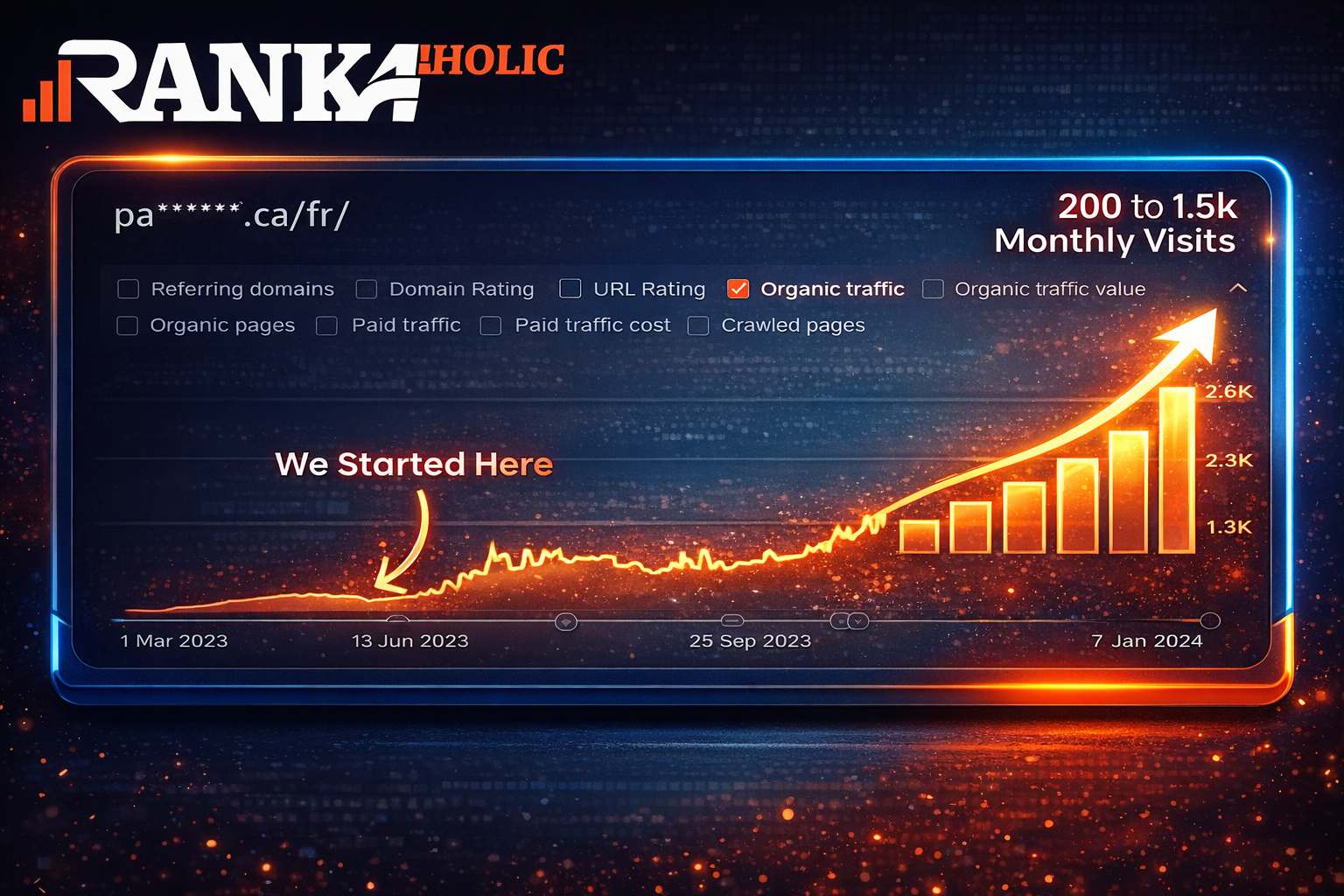
Months 4-6: The compound effect started. Keywords we’d targeted began appearing on page 2. A few moved to page 1. Monthly traffic climbed from 200 to 800. Not explosive, but consistent.
Months 7-12: Authority compounded. Their Domain Rating climbed from 14 to 58. Referring domains went from 68 to over 210. And most importantly, monthly organic traffic reached 30,000.
The breakdown of their 150 acquired links:
- 62 from guest posts (41%)
- 38 from resource page placements (25%)
- 28 from roundup features (19%)
- 14 from product reviews (9%)
- 8 from brand mention reclamation (6%)
Every link was white-hat. Every placement was relevant. Many links came from sites we had long-term relationships with. And the results compounded month after month.
Read the full case study: How Rankaholic Helped Guyker From 200 to 30,000 Monthly Traffic
Common Link Building Mistakes (That Slow Your Results)
Before we close, let’s address mistakes we see eCommerce brands make constantly:
Quantity Over Quality: Prioritising quantity over quality. 100 low-authority links will hurt you more than help you. Focus on 20 relevant, high-authority links from sites your customers actually read.
Lazy Outreach: Using the same outreach email template for everyone. Personalisation matters. Site owners can tell when you’ve mass-blasted them. Custom emails have 5-10x higher response rates.
Weak Anchor Content: Building links without having content worth linking to. You need cornerstone guides, product comparisons, or original research on your site first. Outreach is pointless without something worth linking to.
Poor Anchor Text: Ignoring anchor text strategy. Avoid over-optimised anchors like “[keyword] eCommerce platform.” Use a mix of branded, generic, and descriptive anchors that read naturally.
Impatience: Expecting instant results. Links compound over time. You won’t see significant traffic increases for 5-6 months. Patience is essential.
Wrong Agency Partner: Working with low-quality link building agencies that sell bulk links. These links get devalued or cause penalties. Invest in manual, relationship-driven outreach instead.
Ready to Build Real Authority for Your eCommerce Brand?
Link building works. But it only works if you do it right.
At Rankaholic, we’ve spent over a decade building high-quality, niche-relevant backlinks for eCommerce brands, SaaS companies, and online retailers. We’ve grown brands from 200 monthly visitors to 30,000+. We’ve taken Domain Ratings from single digits to 50+.
Here’s how we work:
We start with a clear assessment of your link profile and competitive landscape. Where are you now? Where do your competitors rank? What’s the authority gap?
We research and vet prospects based on real metrics. Domain authority, organic traffic, spam score, link profile quality. We don’t work with low-quality sites.
We build relationships. We personalise every outreach. We create content that host sites actually want to publish. We treat this as a partnership, not a transaction.
We report and track. Every month, you get a full breakdown of links acquired, domain authority movement, referring domain growth, and keyword position changes.
The result? Sustainable, authority-driven growth that compounds over time.
If you’re ready to stop spinning your wheels with SEO and start building genuine authority, let’s talk. Book a free strategy call and we’ll assess your current situation, identify your biggest opportunities, and show you exactly how we’d approach your eCommerce brand.
No obligation. No sales pitch. Just an honest conversation about your growth.
Resources to Get Started
Want to audit your own link profile before reaching out? We’ve built two free tools to help:
Free DA PA Checker Tool: Check the Domain Authority and Page Authority of any URL instantly. No signup required.
Free LLMS.txt Generator: Create an optimised LLMS file for your website to improve how AI systems understand your content structure.
For a deeper dive into link building strategy, check out our guide on manual link building services. For eCommerce brands specifically, our full case study and link building service page show exactly how we’d approach your brand.
Our link building service has delivered results for over 100 clients across dozens of niches. From music and guitar brands to outdoor gear companies, beauty retailers, and everything in between—we build links that move rankings and drive real, sustainable organic traffic.
Ready to get started? Contact us at harry@rankaholic.co.uk or book your free strategy call today.
Hammad Adil is CEO and founder of Rankaholic, a Bradford-based SEO and link-building agency specialising in manual blogger outreach and sustainable authority building for eCommerce brands, SaaS companies, and online retailers.

