

White Hat Blogger Outreach: How Manual Link Building Actually Works
Quick answer: White hat blogger outreach is the process of finding real, relevant blogs, building a genuine relationship with their editors, and earning a link by contributing content or value their readers want. It is manual: every site is researched, every email is personalised, and every link sits naturally inside useful content. It is slower than buying links, but it builds authority that lasts and keeps you within Google’s guidelines.
Key takeaways
- Outreach is a research job first and a writing job second. Most of the work happens before the first email.
- Personalised pitches get far more replies than templates. Editors can spot a mass email instantly.
- The value you offer, such as a genuinely useful article, data or expertise, decides whether you get the link.
- Track everything: prospects, emails, replies, live links and their impact on rankings.
What is the difference between white hat and black hat outreach?
| White hat outreach | Black hat tactics | |
|---|---|---|
| Sites | Real blogs with real readers | PBNs and link farms |
| Process | Manual research and personal pitches | Automated or bulk purchases |
| Content | Written for the host’s audience | Spun or thin content |
| Anchor text | Natural and varied | Repeated exact-match keywords |
| Risk | Low | Penalties, wasted budget |
| Results | Gradual, compounding | Short-lived, if any |
Google’s spam policies specifically target link schemes, including buying links that pass ranking credit and large-scale guest posting campaigns with keyword-rich anchors. White hat outreach focuses on relevance and value, which is what Google wants links to represent.
Step 1: Set clear goals and choose target pages
Before finding a single blog, decide what you want links to achieve. Which pages need to rank? Which keywords matter most? Are you building topical authority in a new category, supporting a product launch or strengthening your homepage?
Pick a handful of target pages: usually key service or category pages and a few strong guides. Check that each page deserves links. If a page is thin or outdated, improve it first. Outreach cannot rescue weak content.
Step 2: Find relevant blogs
Build a prospect list using several methods:
- Search operators:
[niche] "write for us",[niche] "guest post",[niche] intitle:"contribute". - Competitor backlinks: export referring domains of competitors from Ahrefs or Semrush and filter for blogs in your niche.
- Content searches: find blogs already writing about your topic, even if they never mention guest posts.
- Social and newsletters: bloggers active on LinkedIn, Instagram or Substack in your industry.
Aim for relevance over volume. Fifty well-matched prospects beat five hundred random ones.
Step 3: Vet every blog
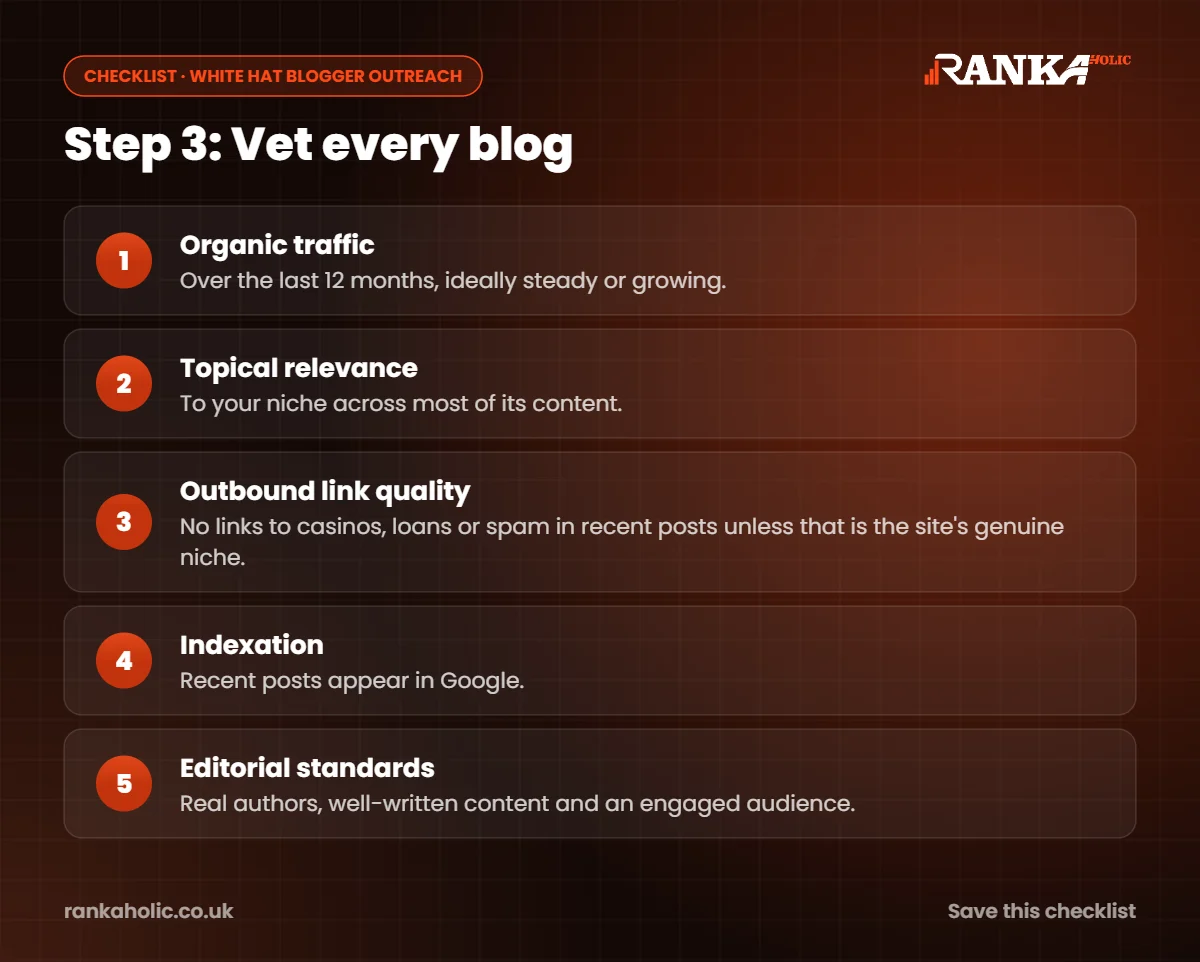
Vetting is where white hat outreach earns its name. For each prospect, check:
- Organic traffic over the last 12 months, ideally steady or growing.
- Topical relevance to your niche across most of its content.
- Outbound link quality: no links to casinos, loans or spam in recent posts unless that is the site’s genuine niche.
- Indexation: recent posts appear in Google.
- Editorial standards: real authors, well-written content and an engaged audience.
We remove roughly half of the prospects we find at this stage. It saves time and protects your link profile. Our full process is in our guide to analysing a blogger before outreach.
Step 4: Find the right contact
Sending a pitch to a generic info@ address lowers your chances. Look for the editor, content manager or blog owner by name on the about page, author bios, LinkedIn or the contact page. Addressing a real person by name shows you have done your homework.
Step 5: Write a pitch that gets replies
A good outreach email is short, specific and about the editor’s readers, not about you. A simple structure works:
- A personal opening: reference a specific recent post and what you found useful in it.
- The offer: two or three specific article ideas that fill a gap on their blog.
- Proof: a line on why you are qualified to write it, with a link to a previous piece.
- An easy next step: ask which idea they prefer.
Here is an example:
Hi Sarah, I enjoyed your piece on winter container gardening, especially the tip on wrapping pots in hessian. I noticed you have not covered growing herbs indoors over winter yet. I could write a practical guide on that, or on choosing grow lights for a small flat. I run a houseplant shop and have written for several gardening blogs. Would either of those suit your readers?
No flattery overload, no talk of “link juice” and no request for a dofollow link in the first email.
Step 6: Follow up, once or twice
Editors are busy. A polite follow-up after five to seven days often gets a reply. If there is still no answer after a second follow-up, move on. Repeated chasing damages relationships and your sender reputation.
Step 7: Write content worth publishing
Once an editor says yes, deliver an article that is better than they expected. Follow their guidelines on length, tone and formatting. Write for their readers, not for search engines. Include one natural link to your target page where it genuinely helps, plus links to other useful sources, including the host’s own articles. Supply properly licensed images and deliver on time.
Quality content is what turns a one-off placement into an ongoing relationship. Many of our best links come from editors who invite us back because previous articles performed well for them.
Step 8: Track links and results
Keep a simple tracker with each prospect, contact, date pitched, reply, agreed topic, publication date, live URL, anchor text and target page. Once links are live, check that they stay live, that the page is indexed, and how your target pages move in rankings and organic traffic over the following months.
How long does white hat blogger outreach take to work?
Expect the first links within a few weeks of starting outreach, and early ranking movement within two to three months. Stronger, compounding results typically arrive over five to six months. Outreach is an investment in authority that keeps paying off, not a quick fix.
Is blogger outreach the same as buying guest posts?
Not quite. Some outreach involves paying for content creation or an editorial fee, which is common in many niches. The difference is in what you are paying for and where. White hat outreach targets real blogs with real readers, places content that genuinely serves those readers and uses natural anchors. Buying placements on link farms or PBNs, or scaling keyword-stuffed guest posts across hundreds of low-quality sites, is what Google targets.
Should you do blogger outreach in-house or use an agency?
In-house works if you have time, writing skills and patience. Expect to spend many hours a week on research, vetting and emails. An agency makes sense when you want consistent volume, established relationships with publishers and experienced vetting without the learning curve.
How Rankaholic runs white hat blogger outreach
Manual blogger outreach is the core of what we do. We research and vet every site by hand, personalise every pitch, write content for each host’s audience and report every live link. We never use PBNs or automated link packages. See our manual link building services for how we work and what is included.
Frequently Asked Questions
What is white hat blogger outreach?
It is the manual process of finding relevant, real blogs, building relationships with their editors and earning links by contributing content or value their readers want, in line with Google’s guidelines.
How many outreach emails does it take to get one link?
It varies by niche and pitch quality. Well-researched, personalised pitches to vetted blogs typically get much higher reply rates than mass emails, but expect many prospects to say no or not reply.
Is blogger outreach safe for SEO?
Yes, when it targets real, relevant sites, places genuinely useful content and uses natural anchor text. Large-scale, keyword-stuffed guest posting on low-quality sites is what carries risk.
How long until blogger outreach improves rankings?
Most sites see early movement in two to three months and stronger results over five to six months, depending on competition and link quality.
What should I put in a blogger outreach email?
A personal opening referencing their content, two or three specific article ideas for their readers, a brief line on your expertise and a simple question to reply to.

