

German Guest Posts: How to Get Backlinks on DR 30+ .de Blogs
Quick answer: To rank on Google.de, you need backlinks from German-language websites, ideally real .de, .at and .ch blogs in your niche with DR 30 or higher and genuine German traffic. Use native German writers, follow German labelling rules for sponsored content, and vet sites carefully, because the German market has its own link marketplaces full of low-quality blogs.
Key takeaways
- English links help less than you might think for German rankings. Language and country relevance matter.
- Content must be written by native German speakers. Machine translation is obvious to editors and readers.
- Sponsored posts in Germany are usually labelled as “Werbung” or “Anzeige”. Expect it and plan anchor text accordingly.
- Check that a site’s traffic actually comes from Germany, Austria or Switzerland, not just that it has a .de domain.
Why do you need German backlinks to rank in Germany?
Google ranks pages for each country and language. A page competing for “Schwarzkümmelöl kaufen” or “Steuerberater Berlin” is judged largely against other German-language pages, and the links pointing to those pages come mostly from German sites.
If your German pages only have links from English websites, you send mixed signals. Google can still understand the links, but links from relevant German sites give a much clearer signal that your page is trusted in the German market. We see this repeatedly with online shops expanding into the DACH region (Germany, Austria and Switzerland): the shops that build German links rank, while those relying on their English link profile stall on page two.
Who needs German guest post backlinks?
- German online shops and Shopify stores.
- International brands launching a German site or subfolder.
- SaaS companies targeting German businesses.
- Local German service businesses, from lawyers to tradespeople.
- Travel, education and finance companies serving German-speaking customers.
What makes a good German guest post site?
| Check | What good looks like |
|---|---|
| Language | Native German content, well written |
| Traffic location | Most organic traffic from Germany, Austria or Switzerland |
| Domain Rating | DR 30+ as a starting filter |
| Topical fit | Covers your niche, such as Gesundheit, Garten, Technik or Finanzen |
| Traffic trend | Stable or growing over 12 months |
| Outbound links | Moderate, relevant, not dozens of paid links per post |
| Imprint (Impressum) | Real publisher details, as required in Germany |
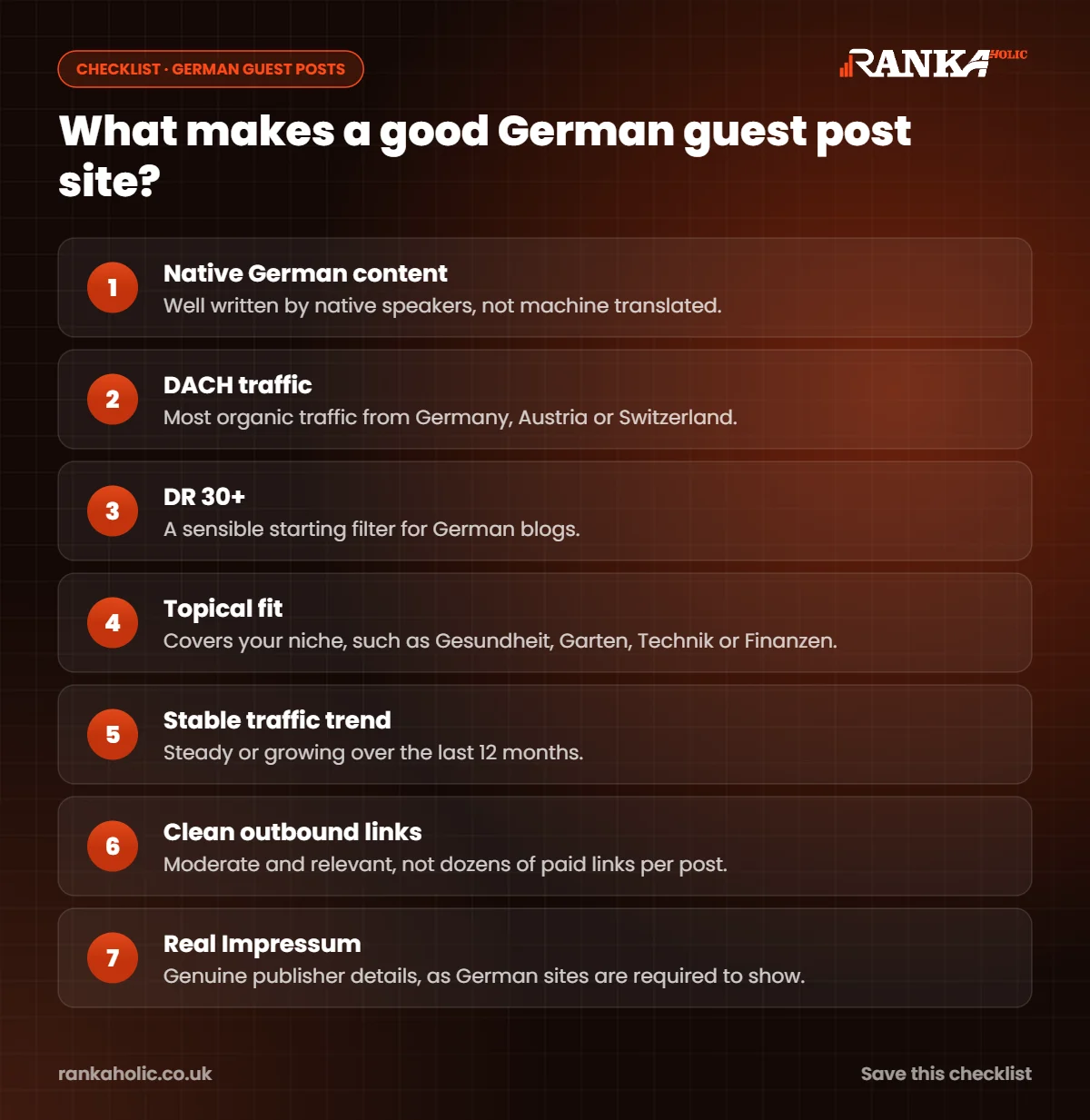
The Impressum check is a useful German-specific trust signal. German websites are generally required to publish an imprint with the operator’s details. A missing or obviously fake Impressum is a red flag.
Why is DR 30+ a sensible threshold for German blogs?
The German web has fewer very high-authority blogs than the English web, so DR scores tend to be lower for sites of similar quality. A DR 30 German niche blog can be a genuinely strong publication. Insisting on DR 60+ German sites narrows your options to large magazines that rarely accept guest posts.
That is why we use DR 30+ as a filter, then judge each site on real German organic traffic, topical relevance and editorial quality. A DR 28 gardening blog with 10,000 monthly German visitors beats a DR 45 site with no traffic every time.
How do you find German blogs that accept guest posts?
Use German search terms, because many German blogs never use the English phrase “write for us”. Useful searches include:
Gastartikel [Thema](guest article)Gastbeitrag schreiben [Thema](write a guest post)"Gastautor werden"(become a guest author)Kooperation Blog [Thema](blog collaboration)
Also analyse the backlinks of German competitors in Ahrefs or Sistrix. Sistrix is widely used in Germany and is helpful for checking a site’s visibility index on Google.de. German blogger networks and marketplaces such as those that connect brands with bloggers also exist, but treat them with the same caution as any marketplace: vet every site individually.
What are the rules for labelling sponsored posts in Germany?
This is a general overview, not legal advice. German law and court rulings require commercial content to be clearly recognisable as such. In practice, most German bloggers label paid guest posts with terms like “Werbung” (advertising), “Anzeige” (advertisement) or “Sponsored Post”.
Google’s own guidelines also say that paid links should be marked with rel="sponsored" or rel="nofollow". Many German publishers follow this. Be realistic about what you are buying: the value of a sponsored German post comes from the relevance, traffic and brand exposure of a real site, not from manipulating link attributes. Earned, editorial German links, such as expert contributions accepted on merit, carry no labelling requirement.
Why must German guest posts be written by native speakers?
German readers and editors notice translated content immediately. Awkward word order, wrong formality (du versus Sie), English idioms translated literally and incorrect compound nouns all undermine trust. Many good German blogs will reject a machine-translated article outright.
Native writers also understand regional and cultural context. A gardening article for German readers should reference German climate zones and seasons, local plant names and German shopping habits, not a translated American guide.
Choose the right form of address too. Many lifestyle and hobby blogs use the informal “du”, while professional, legal and B2B sites usually use “Sie”. Match the host blog’s style.
What topics work for German guest posts?
German readers value thoroughness, clarity and practical detail. Content that performs well includes:
- Ratgeber (practical guides): step-by-step how-tos with clear structure.
- Comparisons and tests: German readers trust detailed comparisons with clear criteria.
- Seasonal content: Garten im Frühling, Winterreifen, Steuererklärung deadlines.
- Quality and origin: organic, regional and certified products resonate strongly, for example Bio-Siegel and quality seals.
- Legal and practical explainers: what a new regulation means for consumers or small businesses.
How should anchor text work for German backlinks?
Use natural German anchors. Mix your brand name, descriptive phrases such as “in diesem Ratgeber zu Schwarzkümmelöl” and occasional keyword-rich anchors. Avoid repeating the same exact-match German keyword across every post. If a post is labelled as sponsored, branded and natural anchors are especially sensible.
What affects the price of German guest posts?
German guest posts often cost more than equivalent English posts, because the pool of quality sites is smaller and native writing costs more. Prices depend on:
- The site’s real German traffic and visibility.
- The niche. Finance, health and legal topics cost more than hobby niches.
- Whether content writing is included, and its length.
- The blogger’s own policies on labelling and link attributes.
Very cheap German posts are almost always on low-quality sites built for selling links.
Common mistakes with German link building
- Using English links for German pages. They help less than relevant German links.
- Machine translation. It damages credibility and gets rejected.
- Ignoring Austria and Switzerland. .at and .ch sites with German content are also relevant for the DACH market.
- Not checking traffic location. Some .de domains get most of their traffic from elsewhere.
- Skipping the Impressum check. It is a quick, useful trust filter.
How Rankaholic builds German backlinks
We build German links for international and German brands through manual outreach to real German-language blogs with genuine DACH traffic. Content is written by native German speakers, sites are checked for traffic, relevance, outbound links and Impressum details, and every placement is reported. We have experience growing German Shopify stores in competitive categories, and we approach every German campaign with the same vetting standards as our manual link building services. Running campaigns in other markets too? See our guides to Dubai guest posts and Spanish guest posts.
Frequently Asked Questions
Do I need German backlinks to rank on Google.de?
For competitive German keywords, yes. Links from relevant German-language sites give a clearer signal of trust in the German market than links from English sites.
Is DR 30 good for a German blog?
Yes, it is a sensible threshold. German blogs tend to have lower DR scores than English sites of similar quality, so judge them on real German traffic and relevance too.
Do German guest posts have to be labelled as advertising?
Paid posts in Germany are usually labelled as Werbung or Anzeige to make their commercial nature clear. Earned editorial contributions do not need labelling. Take legal advice for your situation.
Can I translate English guest posts into German?
It is better to have native German writers create original content. Translated articles often read unnaturally and many German editors reject them.
Are Austrian and Swiss sites useful for German SEO?
Yes. German-language sites on .at and .ch domains are relevant for the DACH market and can support rankings on Google.de.

