

Music Guest Post Backlinks: How Artists, Labels and Gear Brands Get DR 40+ Links
Quick answer: Music guest post backlinks are links from articles you contribute to real music blogs, gear review sites and music education websites. The strongest come from DR 40+ blogs with genuine readers in your exact corner of music, such as guitar, production, classical or a specific genre. Pitch practical, expert content, link naturally to a relevant page, and avoid “music” sites that publish anything for a fee.
Key takeaways
- Music is a broad niche. A guitar pedal brand needs guitar blogs, not hip-hop news sites.
- Gear, production and teaching content earns links far more easily than “listen to my new single” pitches.
- Guest posts work best alongside reviews, interviews and resource page placements.
- We grew a guitar hardware brand from 200 to 30,000 monthly organic visits largely through niche music links. The Guyker case study shows how.
Who needs music backlinks?
Music searches are crowded with big retailers, streaming platforms and established magazines. Smaller music businesses need relevant links to compete. That includes:
- Instrument and gear brands, from guitar parts to synths and microphones.
- Music shops and online retailers.
- Recording studios, mixing and mastering engineers.
- Music teachers, schools and online course creators.
- Record labels, publishers and artist management companies.
- Music software, plugin and app developers.
- Independent artists building a fan base beyond social media.
Why are DR 40+ music blogs worth targeting?
A DR 40+ music blog has usually been publishing for years and has earned links from other music sites, forums and press. That makes its links stronger and its audience more established. It is a sensible quality threshold for most campaigns.
But DR is a filter, not a goal. Some of the best music links we have built came from DR 25 to 35 specialist blogs, such as a site dedicated to vintage amps with a small but obsessive readership. We judge every music site on real organic traffic, topical focus and the quality of its other content.
Which music sites give the most valuable links?
| Site type | Best for | Typical link |
|---|---|---|
| Instrument blogs (guitar, drums, keys) | Gear brands, shops, teachers | Guest tutorial, gear guide |
| Music production and home studio blogs | Plugins, microphones, studios | How-to article, roundup |
| Gear review sites | Product brands, retailers | Review or comparison |
| Music education sites | Teachers, courses, apps | Learning guide, resource page |
| Genre and scene blogs | Artists, labels, promoters | Interview, feature |
| Music business and industry blogs | Labels, distribution, services | Expert advice article |
For a curated starting list, see our guide to real music and guitar sites that accept guest posts.
What should you pitch to music blogs?
Music editors get flooded with press releases for new singles. The pitches that stand out teach readers something. Ideas that work well:
- Tutorials: how to set up a guitar’s intonation, how to treat a small room for recording, how to EQ vocals in a busy mix.
- Buying guides: what to look for in a first audio interface, how to choose tuning machines, budget versus boutique pedals.
- Behind-the-scenes expertise: how a mastering engineer approaches loudness, how a luthier selects tonewoods.
- Practice and learning: a 30-day practice plan for beginners, sight-reading tips, ear training exercises.
- Industry advice: how independent artists can pitch playlists, how sync licensing works, how to read a publishing contract.
How do you write a music guest post editors will accept?
A strong pitch gets you a reply. A strong article gets you published and invited back. When we write music guest posts, we follow a few simple rules.
Match the host’s level. A blog for beginner guitarists needs plain language and step-by-step instructions. A production blog read by working engineers expects technical depth. Read five recent posts before writing a word.
Show real experience. Music readers can tell when a writer has never held the instrument. Specific details, such as the exact screwdriver size for a truss rod adjustment or the frequency range where muddiness builds up in a mix, prove expertise.
Add something original. A quick comparison table, a practice routine, audio examples or photos from a real setup make the article more useful than what already ranks.
Keep promotion light. One relevant link to your site, placed where it genuinely helps the reader, is enough. A short author bio can carry your brand name. Anything more feels like an advert, and editors will cut it.
Deliver clean copy. Proofread, format with clear headings, and supply images you have the rights to use. Editors remember contributors who make their job easy.
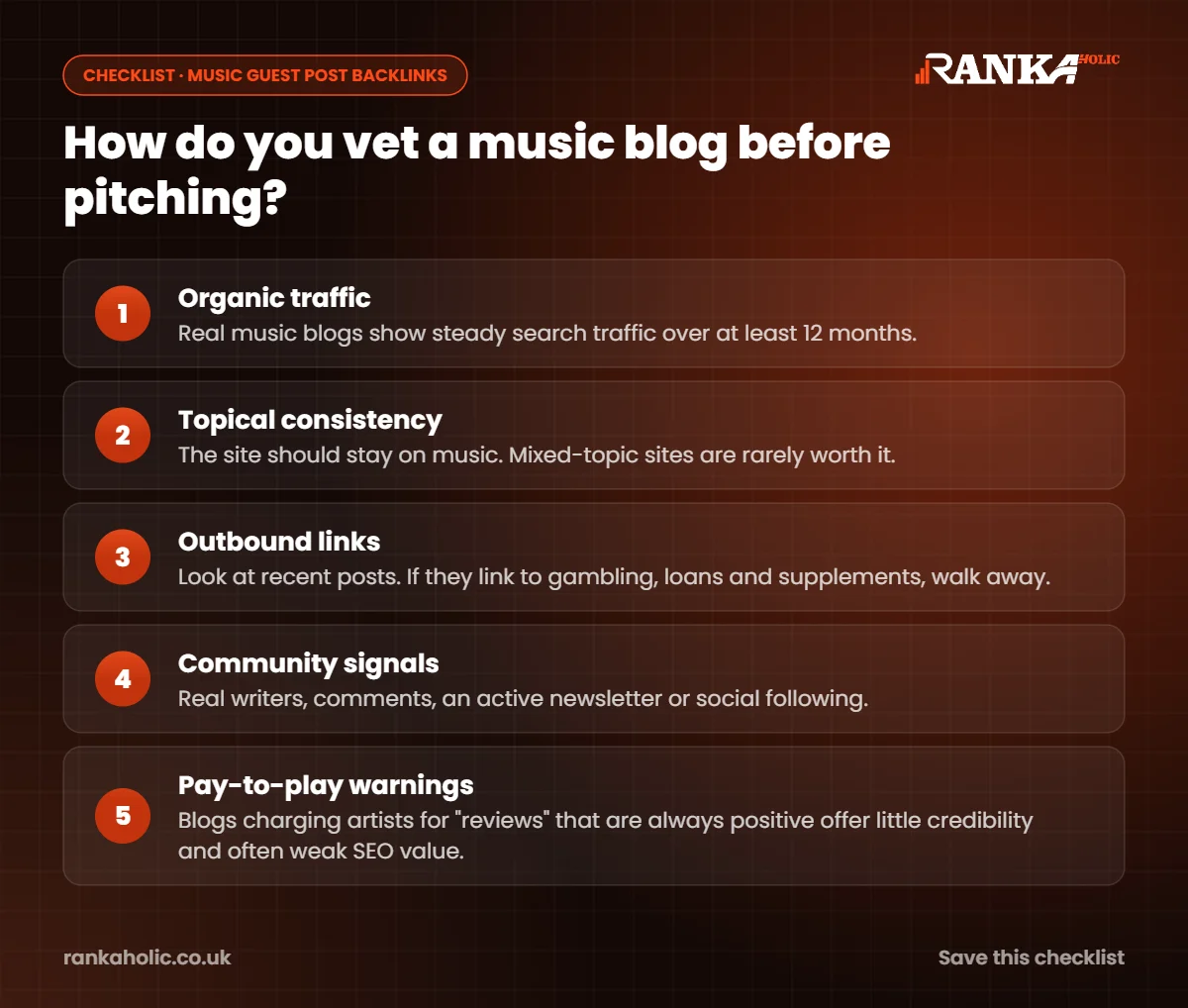
How do you vet a music blog before pitching?
The music niche has its share of fake blogs. Some exist only to sell “premium placements” to hopeful artists. Before pitching, check:
- Organic traffic: real music blogs show steady search traffic over at least 12 months.
- Topical consistency: the site should stay on music. Mixed-topic sites are rarely worth it.
- Outbound links: look at recent posts. If they link to gambling, loans and supplements, walk away.
- Community signals: real writers, comments, an active newsletter or social following.
- Pay-to-play warnings: blogs charging artists for “reviews” that are always positive offer little credibility and often weak SEO value.
Do music links have to be guest posts?
No. Guest posts are reliable, but a strong music link profile mixes several link types. In our Guyker campaign, guest posts made up roughly 41% of links. The rest came from resource page placements, gear roundups, product reviews and reclaiming unlinked brand mentions.
For gear brands, sending products to reviewers and YouTubers who also run blogs is especially effective. For teachers and course creators, resource pages such as “best free guitar learning sites” are a natural fit. For artists, interviews and features on genre blogs often work better than guest articles.
How should music backlinks be anchored?
Keep anchor text natural and varied:
- Brand name anchors, used most often.
- Descriptive anchors such as “these locking tuners” or “this home studio mixing course”.
- Occasional partial-match anchors such as “guitar parts”.
- Very few exact-match commercial phrases.
Link to the page that matches the article. A tuning stability tutorial should link to your tuners product page, not your homepage.
How long do music backlinks take to work?
In our experience, the first three months are often quiet. Rankings tend to start moving in months four to six as links are indexed and authority builds. For Guyker, traffic rose from 200 to around 800 monthly visits by month six, then compounded to roughly 30,000 by month twelve as Domain Rating grew from 14 to 58. Every niche and starting point is different, but steady, relevant link building over six to twelve months is what produces results like that.
Common mistakes in music link building
- Pitching releases instead of value. Editors ignore “check out my new single” emails. Offer something useful.
- Targeting the wrong corner of music. A drum brand gains little from a classical piano blog.
- Buying “music blog” packages. Bulk packages are almost always link farms.
- Neglecting your own content. Without a good guide or product page to link to, outreach struggles. Build linkable assets first.
How Rankaholic builds music backlinks
Music is one of our core niches. We research and vet real music blogs, gear review sites and music education websites, pitch tailored guest content, run product review outreach and reclaim brand mentions. Every placement is reported monthly. Learn more on our music backlinks service page, or read how we approach manual link building across niches.
Frequently Asked Questions
What are music guest post backlinks?
They are links to your website placed inside articles you contribute to music blogs, gear sites or music education websites. They build authority and relevance for music-related searches.
Are DR 40+ music blogs better?
They are often more established and pass stronger links, but real traffic and topical relevance matter more. A smaller specialist music blog with engaged readers can be the better choice.
Can independent artists use guest posts?
Yes. Artists can write about songwriting, production, touring or the music business on relevant blogs. Interviews and features on genre blogs also work well.
How much do music backlinks cost?
Costs depend on the site’s quality, traffic and the work involved in outreach and content. Be wary of very cheap packages, which are usually low-quality sites.
What is the fastest way to get music backlinks?
Combine guest posts on relevant music blogs with resource page outreach and product review outreach. Building a few strong linkable guides on your own site first makes every method more effective.

