

Hunting and Outdoor Backlinks: How to Get Links on Real Hunting, Outdoor and Survival Sites
Quick answer: The best hunting and outdoor backlinks come from real, active sites in the niche: gear review blogs, hunting and fishing magazines, conservation organisations, survival and bushcraft blogs and local outfitters. You earn them with useful guest content, product reviews and resource page placements, not bulk link packages. Expect to vet ten sites for every one worth pitching.
Key takeaways
- Relevance beats raw authority. A DR 30 hunting blog with real readers is worth more than a DR 70 general news site.
- The outdoor niche is full of thin “review” sites built for affiliate links. Always check real organic traffic before paying for anything.
- Firearms and knife content has advertising and payment restrictions, so some sites will not accept certain products. Ask early.
- Seasonality matters. Pitch hunting content two to three months before the season opens.
Why do hunting and outdoor brands need niche backlinks?
Hunting, fishing, camping and survival searches are dominated by a small group of established publishers and big retailers. If you run an optics shop, a camo clothing brand, a guide service or a survival gear store, you are competing with sites that have earned links for over a decade.
Google uses links as one of its strongest signals of trust. When a respected hunting blog links to your page about bow sights, it tells Google two things at once: that your page is credible, and that it belongs in the hunting topic. That second signal, topical relevance, is why a handful of niche links often moves rankings faster than dozens of generic ones.
There is also a direct traffic benefit. Outdoor readers are loyal to the blogs they follow. A link inside a well-read gear guide can send buyers who are already in research mode.
What types of sites give the best outdoor backlinks?
Not every site with “outdoor” in the name is worth a link. These are the categories we prioritise when we build links for outdoor brands:
| Site type | Typical link | Value |
|---|---|---|
| Hunting and fishing blogs | Guest post or gear mention | High relevance, steady traffic |
| Gear review sites | Product review or roundup inclusion | High buyer intent |
| Survival, prepper and bushcraft blogs | How-to guest post | Strong for knives, kits, food storage |
| Camping and hiking sites | Resource page or checklist link | Broad reach, good for crossover products |
| Conservation and land management sites | Sponsorship, data or expert quote | High trust, harder to earn |
| Regional outfitters and guides | Partner or “recommended gear” link | Local relevance |
How do you find real hunting and outdoor sites that accept guest posts?
Start with Google, not a vendor’s site list. Search operators surface active blogs quickly:
hunting "write for us"bushcraft "guest post"fishing blog "contribute"camping intitle:"submit a guest post"
Then look at where your competitors get their links. Put a competitor’s domain into Ahrefs or Semrush, filter referring domains to the outdoor niche and note the sites that link to more than one competitor. Those sites clearly link to brands like yours.
Finally, look beyond “write for us” pages. Many of the best outdoor blogs never advertise guest posting but will happily publish a genuinely useful article, such as a field-tested guide to layering for late-season hunts, if you pitch it well.
How do you vet an outdoor site before you pitch?
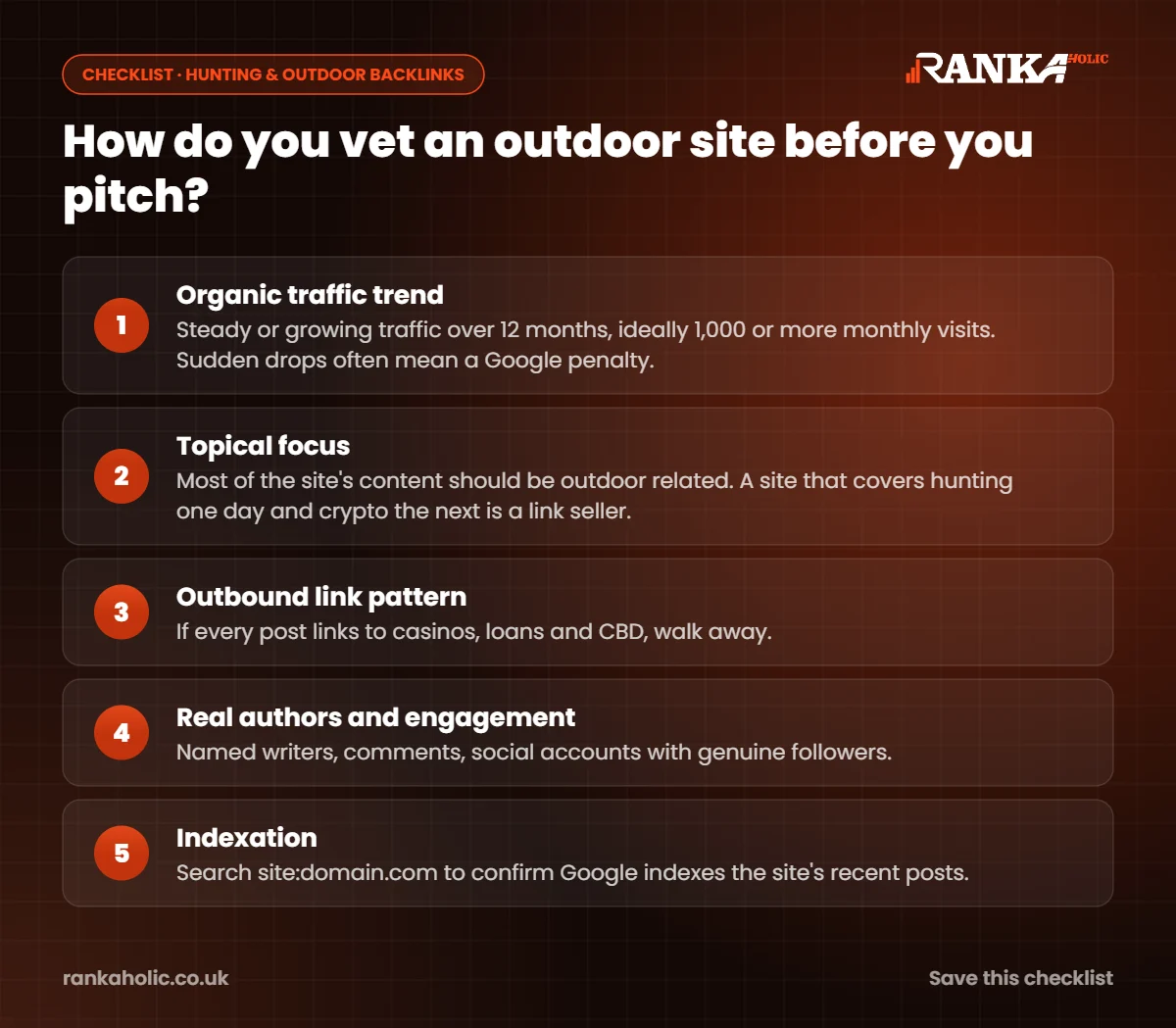
This is where most outdoor link building goes wrong. The niche has thousands of sites that look fine on metrics but have no real readers. Before we contact any site, we check:
- Organic traffic trend. Steady or growing traffic over 12 months, ideally 1,000 or more monthly visits. Sudden drops often mean a Google penalty.
- Topical focus. Most of the site’s content should be outdoor related. A site that covers hunting one day and crypto the next is a link seller.
- Outbound link pattern. If every post links to casinos, loans and CBD, walk away.
- Real authors and engagement. Named writers, comments, social accounts with genuine followers.
- Indexation. Search
site:domain.comto confirm Google indexes the site’s recent posts.
We cover this process in more detail in our guide on how to analyse a blogger for link building.
What should you pitch to hunting and outdoor bloggers?
Outdoor editors are practical people. They want content their readers will use in the field. Topics that get accepted:
- Seasonal guides: pre-season scouting checklists, cold-weather layering, first-time deer hunt preparation.
- Skills content: field dressing basics, knot guides, map and compass navigation, fire lighting in wet conditions.
- Honest gear comparisons: budget versus premium rangefinders, synthetic versus down insulation.
- Safety and ethics: tree stand safety, shot placement for ethical hunting, leave-no-trace principles.
Your link should sit naturally inside that content, pointing to a page that adds value, such as a sizing guide or a detailed product page. Avoid pitching thinly veiled adverts. Editors in this niche spot them instantly.
Are there restrictions on firearms, knives and hunting content?
Yes, and they affect link building. Some publishers avoid linking to firearm retailers, ammunition or certain blades because of advertising network rules or their own policies. Laws also differ between the UK, the US and Europe, so a product that is fine to promote in Texas may be restricted in the UK.
The practical answer is to ask the editor up front what they can and cannot link to, and to point links at informational pages, such as a maintenance guide or a buyer’s guide, when product pages are not allowed.
How many hunting backlinks do you need?
There is no fixed number. Compare your referring domains with the top three sites ranking for your main keywords. If they have 80 relevant referring domains and you have 15, you have a gap to close. Most outdoor brands see meaningful movement with five to ten quality niche links a month, built steadily rather than in one burst.
Common mistakes in outdoor link building
- Buying cheap “outdoor” link packages. These are usually private blog networks dressed up as niche sites.
- Exact-match anchor text everywhere. Fifty links that all say “best hunting boots” look manipulative. Mix branded, natural and partial anchors.
- Ignoring the season. A duck hunting guest post pitched in July lands well. The same pitch in December is too late.
- Linking only to the homepage. Deep links to category and guide pages spread authority where you need it.
How Rankaholic builds hunting and outdoor backlinks
We run manual outreach to real hunting, fishing, camping and survival sites. Every site is vetted for traffic, relevance and link history before we pitch, every article is written for the host’s readers, and you see each placement in a monthly report. For the full details of how we work in this niche, see our SEO link building for hunting and outdoor brands page, or our wider manual link building services.
Frequently Asked Questions
What are hunting backlinks?
Hunting backlinks are links to your website from real sites in the hunting and outdoor niche, such as hunting blogs, gear review sites and outdoor magazines. They help search engines see your site as relevant and trustworthy for hunting-related searches.
Are outdoor guest posts still worth it?
Yes, when they are on real, vetted sites with genuine readers. Guest posts on relevant outdoor blogs build topical authority and can send buyers directly to your site. Posts on link farms or unrelated sites add little value and carry risk.
How do I know if an outdoor site is a link farm?
Check its organic traffic trend, whether its content stays on outdoor topics, and who else it links to. Link farms usually have flat or falling traffic, cover unrelated subjects and link out to casinos, loans and other high-risk niches.
Can survival and prepper sites help a hunting brand?
Yes. Survival, bushcraft and prepper audiences overlap heavily with hunters, especially for knives, optics, clothing, shelters and food storage. Links from these sites still count as topically relevant.
How long do outdoor backlinks take to work?
Most sites see early movement within two to three months and stronger results over five to six months, depending on competition and how many quality links are built.

